



How to Regulate Emotions in 4 Minutes (with Brain Science)
Let’s say the quiet part out loud.
A lot of “nervous system regulation” advice feels exhausting.
Breathe this way.
Tap this point.
Do this somatic drill.
Journal for 45 minutes.
Repeat every day forever.
And if you live with chronic illness, chronic pain, gut issues, hormone symptoms, mystery fatigue, or constant stress?
That advice can feel like one more job.
One more thing to fail at.
One more reason to wonder, “Why am I still not better?”
Here’s the truth: your emotions are not the enemy.
They are not a sign you are weak.
They are not proof you are broken.
They are data.
And when you know how to process them, they can actually help calm the storm instead of feeding it.
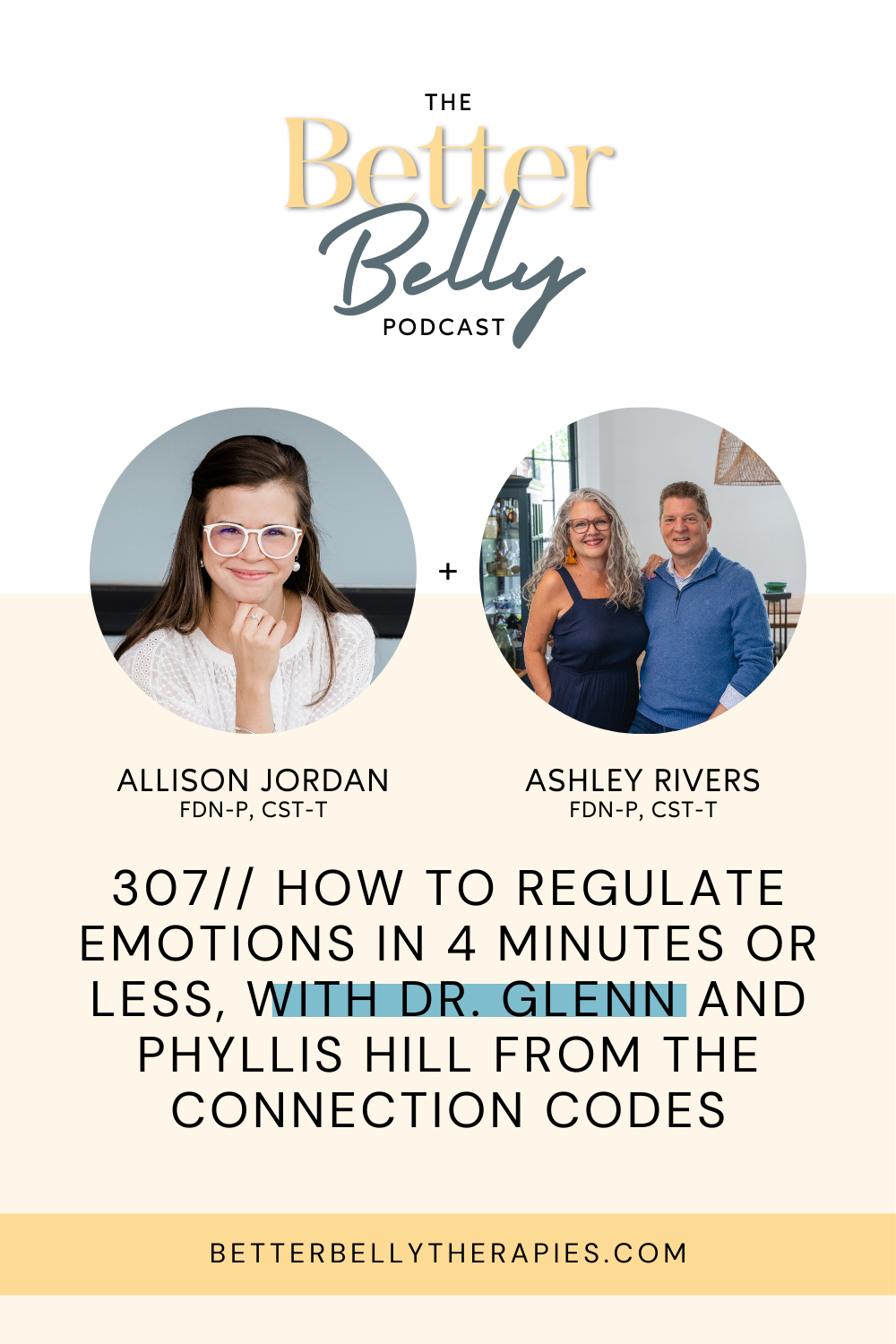
In this podcast episode, I sat down with Dr. Glenn and Phyllis Hill, founders of Connection Codes, to talk about emotional regulation, unprocessed emotions, chronic illness, and the brain science behind all of it.
What they shared was simple.
Practical.
And honestly? Very relieving. 🙌
Because if you have ever felt like your emotions are “too big” to deal with, this matters.
And if you’ve been searching for KEYWORD because your body feels stuck in fight-or-flight, this is for you too.
Why Chronic Illness, Stress, and Suppressed Emotions Make You Feel Dysregulated
When your body already feels under attack, even a small trigger can feel huge.
A symptom flares.
A hard conversation happens.
A lab result comes back weird.
A doctor dismisses you.
Your stomach hurts again.
Suddenly, you are spiraling.
That does not mean you are dramatic.
It does not mean you are failing at healing.
It often means your body has been carrying more than it can process.
Dr. Glenn described this like an emotional dam.
At first, that image hit me hard.
Because so many people with chronic illness are not reacting to one moment.
They are reacting to months or years of stored hurt, fear, grief, loneliness, guilt, and anger.
Then one tiny thing happens…
And the whole dam bursts.
That’s why you can feel wrecked by “small” things.
It was never just the small thing.
It was the symptom flare on top of the doctor trauma.
The sleep loss on top of the food fear.
The marriage stress on top of the body pain.
The grief on top of the constant uncertainty.
This is also why mainstream advice often misses the mark.
It treats dysregulation like a random glitch.
But often, your nervous system is responding to unprocessed emotional load.
That distinction matters.
Because if the real issue is emotional backlog, then the answer is not more suppression.
The answer is processing.
Not stuffing.
Not pretending.
Not “choosing joy” while your body screams otherwise.
Processing.
This is where Connection Codes becomes so powerful.
It gives you a simple tool to notice what is happening inside you in real time.
That matters for chronic illness healing.
Because when your body stays in chronic threat, digestion, sleep, hormones, detox, and immune function all take a hit.
You can learn more about the Better Belly Blueprint if you want a root-cause framework for healing the body as a whole.
But emotional processing belongs in that conversation too.
Gut health is not separate from your inner world.
Neither are your hormones.
Neither is your pain.
The Brain Science Behind Emotional Regulation: The 8 Core Emotions and Connection Codes
One reason I loved this conversation is that it does not float around in vague self-help language.
It gets practical.
According to Dr. Glenn and Phyllis, five neural regions in the brain fire emotions. From that, they teach eight core emotions:
-
Joy
-
Sad
-
Hurt
-
Lonely
-
Fear
-
Anger
-
Guilt
-
Shame
That’s it.
Not 300 emotions.
Not a giant wheel that makes you feel more confused.
Not a vocabulary test.
Just eight.
And for people who struggle to identify what they feel, that is GOLD.
They explained that many common words people use, like “stressed,” “overwhelmed,” or “bothered,” are not always core emotions. Often, they are result words.
That means stress may be what happens after fear, hurt, loneliness, or anger goes unprocessed.
That idea is a game changer.
Because you can’t fully process “overwhelmed” if the real issue is fear.
You can’t move through “stressed” if what you really feel is hurt and lonely.
Here’s another important point they shared: the brain does not sharply separate emotional pain from physical pain.
Read that again.
If emotional pain affects the brain like physical pain, then unprocessed emotions are not “just in your head.”
They affect your whole system.
No wonder chronic illness can feel worse during relational stress.
No wonder symptom flares hit harder when grief is present.
No wonder your body struggles when your heart is carrying too much.
This is why I keep saying root-cause healing must include the whole person.
Not just labs.
Not just supplements.
Not just diet.
The whole person.
And yes, I still love functional medicine tools.
I still care about SIBO, mold, mineral imbalances, hormones, fascia, detox, and inflammation.
But let’s be honest:
You can run the cleanest protocol on earth and still feel stuck if your body lives in unresolved threat.
That’s why this conversation around KEYWORD, nervous system regulation, and emotional processing matters so much.
Why “Just Calm Down” Backfires for Nervous System Regulation and Emotional Healing
Most people were never taught how to process emotions.
They were taught how to shut them down.
“You’re okay.”
“Don’t cry.”
“Let it go.”
“Be positive.”
“Choose joy.”
“Stop overreacting.”
That sounds nice.
But it often trains the body to disconnect from itself.
Phyllis shared that for years, she believed she could opt out of emotion.
She focused on tasks.
She stayed productive.
She pushed through.
A lot of high-achieving women do the same thing.
Especially the women I work with.
They are responsible.
Disciplined.
Capable.
Faith-filled.
And deeply overwhelmed.
They know how to function.
But functioning is not the same as processing.
That’s the trap.
You can look “fine” while your body stores everything.
Then one day your sleep crashes.
Your digestion tanks.
Your cycle gets worse.
Your skin flares.
Your anxiety spikes.
Your resilience disappears.
And you wonder what happened.
Sometimes what happened is this:
your body got tired of carrying what your heart never had space to feel.
That is why trying to control emotions often backfires.
Control is not the same as regulation.
Suppression is not the same as peace.
White-knuckling your way through life does not heal your nervous system.
It just delays the bill.
And if you live with chronic symptoms, delays get expensive.
Emotionally.
Physically.
Spiritually.
This is also why a lot of people feel worse around healing language that sounds complicated.
They already feel behind.
They already feel tired.
They already feel like healing is a full-time job.
They do not need more pressure.
They need tools that actually fit real life.
That is why I found this framework so refreshing.
It made emotional regulation feel doable.
Not because it was shallow.
But because it was clear.
How to Process Emotions in 4 Minutes or Less With the Core Emotion Wheel
Here is the simple tool Dr. Glenn and Phyllis teach: the Core Emotion Wheel.
You go through the eight core emotions and name what is there.
That’s it.
No essay required.
No perfect wording needed.
No massive emotional deep dive.
You simply slow down and ask:
-
Where do I feel joy?
-
Where do I feel sad?
-
Where do I feel hurt?
-
Where do I feel lonely?
-
Where do I feel fear?
-
Where do I feel anger?
-
Where do I feel guilt?
-
Where do I feel shame?
You can do this alone.
You can do it with your spouse.
You can do it with a trusted friend.
And the response from the listener does not need to be complicated.
Often, they simply say: “Ooh.”
I know that sounds almost too easy.
But that little response matters.
Why?
Because it communicates presence without fixing.
It communicates care without interrupting.
It leaves room for emotion without judgment.
That is powerful.
And here is the wild part: Dr. Glenn shared that emotional processing may take far less time than people assume.
The old number often quoted is 90 seconds.
But in co-regulation, he said it can happen in roughly 20 seconds.
Not always.
Not magically.
Not in every situation.
But often much faster than people think.
That matters because so many people avoid emotions because they think:
“If I start crying, I’ll never stop.”
“If I open this door, I’ll lose the whole day.”
“If I deal with this, it will take hours.”
Not necessarily.
Sometimes the body just needs permission to tell the truth.
And once it does?
Relief comes faster than expected.
That’s why this tool works so well for busy people, exhausted moms, couples, and people navigating chronic illness.
It is simple enough to use today.
Not five years from now.
Not after a certification.
Not after reading ten books.
Today.
If you want more practical healing tools, check the podcast episode vault for other conversations on gut health, chronic symptoms, and root-cause recovery.
Signs You’re Suppressing Emotions vs. Signs You’re Actually Regulated
So how do you know if an emotion is still stuck?
Usually, your body tells you.
Phyllis shared that unprocessed emotions often affect her sleep.
That makes sense.
For some people, the clue is insomnia.
For others, it’s a tight chest.
A lump in the throat.
A clenched jaw.
A heavy stomach.
A racing mind.
A short fuse.
You may also notice:
-
You keep replaying the same conversation
-
You feel reactive to tiny things
-
You cannot take a deep breath
-
You feel numb, flat, or checked out
-
Your symptoms flare after conflict
-
You cannot move on, even when you want to
Those are common signs that something still needs processing.
On the flip side, what does regulation look like?
Not perfection.
Not fake positivity.
Not never feeling upset.
Real regulation looks more like this:
-
You can name what you feel
-
Your body softens after you share it
-
You feel more present
-
You sleep better
-
The issue stops looping
-
You feel connected instead of shut down
That does not mean every hard moment disappears.
It means your body is no longer carrying the emotion alone.
That distinction is huge.
And honestly, this is where many healing journeys stall.
People chase the next supplement.
The next elimination diet.
The next test.
Meanwhile, their body keeps waving a flag that says:
“Please deal with what I’m holding.”
That does not mean emotions cause every illness.
Let’s not get weird.
But it does mean unresolved emotional stress can worsen the terrain in a major way.
That’s why inside root-cause healing, we need both/and.
Yes, investigate the body.
Yes, address the gut.
Yes, run smart labs.
And also?
Pay attention to the heart.
That is not fluff.
That is strategy.
My Takeaway for Chronic Illness Healing: Stop Treating Emotions Like the Enemy
If you are sick, inflamed, exhausted, or discouraged, I want you to hear me clearly:
You do not need to be less emotional.
You need better tools.
That’s different.
Because the goal is not to become a robot.
The goal is to become honest.
Honest about what your body is carrying.
Honest about what your heart is feeling.
Honest about what still hurts.
That honesty can become healing.
This is one reason I wanted Dr. Glenn and Phyllis on the podcast.
Their work brings emotional processing down to earth.
It gives language to people who freeze.
It gives structure to people who flood.
It gives relief to people who thought regulation had to be complicated.
And if you’ve been stuck in the cycle of symptom fear, relationship stress, and internal overload, please do not ignore this.
You do not need more shame.
You do not need another impossible standard.
You need a simple next step.
Start here:
Tonight, do the Core Emotion Wheel.
Take two minutes.
Go through all eight emotions.
Tell the truth.
Then notice what happens in your body.
That tiny shift could open more than you think.
And if you are tired of guessing your way through chronic symptoms, learn more about the Better Belly Blueprint. It is the fastest way to stop wasting time on random fixes and start addressing the real root causes.
Because your healing should not feel like chaos.
And your emotions do not have to keep hijacking your body.
They can become part of the path forward.
Quick Recap
-
Chronic illness often amplifies emotional overload
-
Small triggers can feel huge when unprocessed emotions pile up
-
Connection Codes teaches eight core emotions:
-
Joy
-
Sad
-
Hurt
-
Lonely
-
Fear
-
Anger
-
Guilt
-
Shame
-
-
Words like “stressed” or “overwhelmed” may hide deeper core emotions
-
The Core Emotion Wheel helps you process feelings quickly
-
Emotional regulation is not suppression
-
Signs of stuck emotion include looping thoughts, poor sleep, tightness, and reactivity
-
Real healing often requires both body-based root-cause work and emotional processing
-
If you want a structured healing path, learn more about the Better Belly Blueprint
FAQ
Can chronic illness make emotional regulation harder?
Yes. When your body feels unsafe, symptoms can lower your stress tolerance fast. That makes triggers hit harder.
What are the eight core emotions in Connection Codes?
They are joy, sad, hurt, lonely, fear, anger, guilt, and shame.
Can processing emotions really help my nervous system calm down?
Yes. For many people, naming and expressing emotions reduces internal tension and helps the body settle.
Why do I feel “stressed” but not know what emotion is underneath?
Because stress is often a result word. The deeper layer may be fear, hurt, loneliness, or anger.
Do I need therapy for this to work?
Therapy can help, but this tool is simple enough to start using today on your own or with a trusted person.
Author Bio
Written by Allison Jordan, FDN-P — gut health specialist, functional medicine practitioner, and founder of Better Belly Therapies. Allison helps women uncover the real root causes behind gut, hormone, skin, sleep, and brain symptoms so they can stop guessing and finally heal.

CONNECT WITH THE GUEST:
- Download the Core Emotion Wheel for Free
- Follow Connection Codes on Instagram
- Listen to the Connection Codes Podcast
- Buy The Connection Codes Book
- Get 20% off the Marriage Foundations Masterclass with code: BELLY20
- Get Coaching with Dr. Glenn Hill
HEAL YOUR GUT:
-
- Want to learn how BBB works? Watch this FREE training walking you through how to heal, once and for all!
-
- Want to make sure that VIP is right for you? Book a FREE 20 Min Application Call!
RESOURCES:
- Subscribe to our Weekly Podcast Newsletter
- Download the entire Better Belly Podcast Vault!
- Download my Free Constipation Relief Guide
- Get Full Access to my Liver Detox Protocol for only $7!
- Get the Functional Blood Chemistry Analysis Spreadsheet
LINKS:
- JOIN → Join our FREE Facebook Group
- FOLLOW → @betterbellytherapies
- ASK → Ask a Question for the Podcast
- WORK WITH US → betterbellytherapies.com
SHOW US YOUR LOVE:
- If this podcast episode made positively impacted you, please leave a Rating and Review for the podcast. It'd mean so much! ❤️

+ view comments . . .